Jane Goodall Institute Singapore

Roots & Shoots Intern
September 4 – November 24, 2020

Partnership Reflection
As an organization that operates remotely – even without the constraints of COVID – it may feel alienating and isolating at first to navigate large (months-long) projects. You might feel overwhelmed or frustrated when given tasks without any guidance, especially because everything you will do is self-paced and self-guided. But, it is always reassuring to know that you have the entire Roots & Shoots committee behind your back who is willing to offer feedback when you need it. Working at this partnership taught me the importance of being a self-advocate – to proactively ask questions, request sample texts, or solicit explicit feedback. I also learned how to compartmentalize and prioritize individual tasks – invaluable skills that I will apply in my future. Instead of chipping away at everything inefficiently, I practiced the principles of quality over quantity. This way, I was able to produce products that I was proud of, and that will hopefully maximize the potential of my modules, digital workshops, and the cross-border program.
Amidst all of my setbacks, I found that there is nothing more rewarding than seeing the fruits of your labor – developing resources for an organization that you know will serve the local community positively. I cannot wait for some of these products to be used by local schools (grade 7-12 students) in the upcoming school year. I would like to thank my supervisor Richard Hartung (JGIS Board member) for all of his mentorship, and I cannot wait to see what Roots & Shoots will accomplish in the near future.
Below are a few of the tasks I completed throughout the 3-month partnership. Please note that the nature of an internship at Roots & Shoots is ad-hoc, meaning the responsibilities you are set will vary according to the time of year, the organization’s yearly objectives, and other factors. Also, keep in mind that some people thrive in a structure-less work placement – just because you might be averse to it at first doesn’t mean you shouldn’t give it a try. You might have to overcome a learning curve, but the effort is worth it!

Developed Eco-Literacy Module 6: Crafting Your Own Roots & Shoots Project
The module aims to: 1) Assist participants in understanding the value of youth-led advocacy. 2) Guide participants through activities that will help them identify the final project and theme, craft a S.M.A.R.T goal, and develop a project plan. 3) Engage participants in group discussions and stress the importance of commitment and communication.
Eco-literacy modules are used by local schools in Singapore to supplement their environmental education curriculum. Roots & Shoots provides their partner schools with a 2-paged guide and 90-minute presentation, which are delivered by an external facilitator.
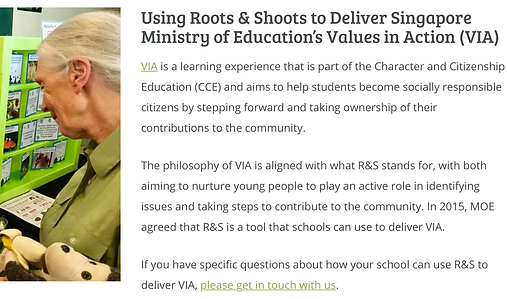
Created 4 Teacher Modules for Partner Institutions
The 60-minute Teacher Modules are used by newly qualified Ministry of Education teachers in Singapore. Roots & Shoots provides their partner schools with a 2-paged guide with relevant educational resources, presentations, and activity ideas to engage students and help instructors teach concepts related to animals, the community, or the environment. All instructors can access these resources on-demand through the new Roots & Shoots website (launch soon).
Topics I developed:
Exploring Biodiversity, Ecosystem Services, Measuring and Reducing our Ecological Footprints, Renewable and Non-Renewable Resources
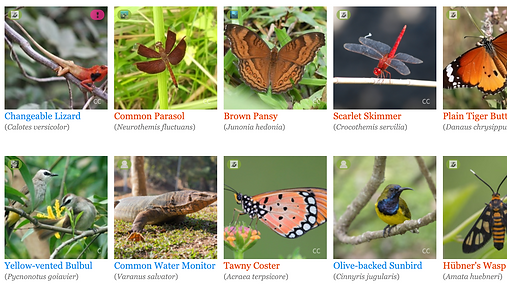
Designed 17 Digital Workshops for 2021-2022 School Year
Roots & Shoots offers their partner institutions 1-2 digital workshops every month throughout the school year. With topics ranging from biodiversity conservation to digital tools, students and teachers are equipped with the knowledge to guide their own Roots & Shoots projects or start a school-wide initiative of their own!
I ideated 17 digital workshop titles and paragraph descriptions that will be used in the upcoming school year. The summaries will be used by the speakers to guide their presentations. All guests are specialists in the field and offer an exclusive opportunity for students to learn about any and all topics surrounding the environment.
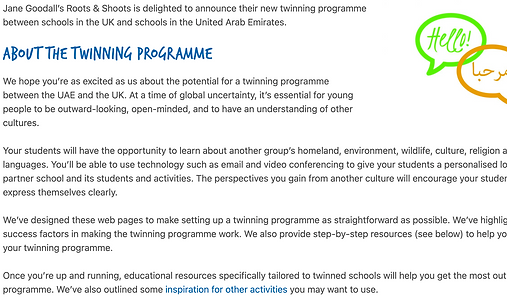
Spearheaded the Cross-Border Programme (2021 School Year)
The Cross-Border Programme is a yearlong, student-led collaboration between chapters in Malaysia, Australia, and Singapore. Through the partnership, groups will obtain insights and feedback from a third party to improve or enhance their Roots & Shoots project. Students will also learn the values of effective leadership and develop their project management skills. Students will organize monthly meetings to update one another on their progress and could choose to coordinate synchronous activities (ex. Beach cleanups) to maintain their link.
I developed a 2-paged guide with appendices describing the potential structure of monthly meetings, a list of all possible communication platforms, and a timeline that chapters could follow to structure their individual initiatives. In addition, I created an orientation presentation that will be used by the organization if there are any signees for the program.
Self-Directed Research


Student-Researcher
August 2020 – April 2021
Research Motive, Objectives, and Takeaways
As part of the AT Research and Composition course for Singapore American School's Quest program, I designed and executed an investigation that attempted to mitigate algal growth in our eco-garden pond. Constructed in 2003 as an experiential education resource, the pond is a habitat for introduced terrapin (invasive), fish, and blue crayfish. Due to the (presumably) excessive input of nutrients such as nitrate and phosphate, algae have proliferated. Without functioning aeration and filtration systems, the death and decay of the photosynthetic microorganisms will deoxygenate the pond ecosystem. Using a convergent mixed-methods approach, I used two species of aquatic plants to monitor algal concentration over six weeks and assessed the SAS community's willingness to implement a remediation protocol for the pond's sustained recovery.
I sought mentorship from Dr. Maxine Mowe, a professor of the Biological Sciences department (specialization in freshwater ecology) at the National University of Singapore. I had the opportunity of visiting the Freshwater and Invasion Biology Laboratory to use their centrifuge and spectrophotometer; equipment that allowed me to quantify algal densities before and after my intervention. The project culminated in a research report and oral defense that was presented before Quest faculty, family members, and my mentor. As someone who wanted to conduct fieldwork to round off their high school career, I am incredibly grateful to have gotten the opportunity to meet and work with passionate academics in this field.
Having never guided a professional research project, I was oftentimes confused and frustrated by the subject-specific language of my seminal papers and the tedious process of presenting and refining my speeches. I learned that mixed-methods studies are not pursued by many researchers for a reason – it's agonizing work. For a long time, I struggled to synthesize the quantitative and qualitative aspects of my paper; it took me a long time to comprehend and articulate how the pond's remediation would benefit the student body. The last few days before the deadline were some of the most mentally taxing moments of my high school career, but I wouldn't trade my senior year experience for the organized chaos of 'regular' school. Well, I would've appreciated a longer moment of reprieve after our oral defense...but that's beside the point. My experiment was a proven success, and I'd like to believe I garnered a bit more interest in our neglected pond. I admittedly did not contribute much to the SAS community the way our student leaders, artists, and athletes do. But my project was borne out of a desire to challenge my learning – both in and outside the classroom – and to preserve a resource that could expand the scope of experiential learning at school.
Thank you to Dr. Martha Began and Mr. Steve Early for cultivating my interest in Environmental Science, Dr. Mowe for patiently teaching me the lab protocols, my parents for their unwavering emotional support, and the Quest program for pushing my academic limits far beyond what I thought I was capable of managing. I am seeking publication in a professional scientific journal currently, and am excited to explore new research opportunities in university.
Abstract
Studies investigating natural eutrophication management strategies in the Malay Peninsula involve rooted, rather than free-floating, macrophytes. Limnological research in Singapore is centered around remediating reservoirs or canals rather than man-made freshwater systems. I quantified the effect of two macrophyte species (Eichhornia crassipes and Pistia stratiotes) on improving the quality of a closed, eutrophic Eco-Garden pond in the Singapore American School (SAS). Water quality, plant biomass, phytoplankton richness and abundance, and chlorophyll-a were examined. Over six weeks, phytoremediation improved water quality by 7.52 units (p < .05), increased the biomass of Pistia stratiotes by 213.03% and Eichhornia crassipes by 303.32%, reduced the abundance of phytoplankton by 0.16 cells/mL, increased richness by 7.69 units, and elevated algal concentrations by 1.03 μg/L. I additionally assessed six SAS stakeholders’ opinions on the pond’s ecological integrity and will to participate in the maintenance process. All respondents believed the pond should be preserved as an educational resource and ecological commons. Five out of six respondents indicated an interest in remediating the pond during co-curricular service activities or through biology and environmental science classes. The quantitative and qualitative results informed a maintenance guide for the SAS community and pond owners in Southeast Asia to independently revitalize their biological communities, minimize nutrient spikes, and stabilize ecosystems. This convergent mixed-methods study demonstrates the potential of free-floating macrophyte species to improve water quality and the utility of a comprehensive regimen on the remediation of freshwater fixtures in the region.
Keywords: eutrophication, aquatic plants, water quality, phytoremediation
Assessing the Efficacy of Phytoremediation in Restoring the Singapore American School Eco-Garden Pond and Evaluating Stakeholders’ Attitudes Towards Ecosystem Preservation
Click above for the link to my research paper
Summer 2022 Internship

Carbon Data Intern
May – August 2022
About Unravel Carbon
As the first AI-powered decarbonization platform in Asia, Unravel converts any company’s accounting data into full supply chain carbon data in seconds. The startup has raised over US$7M in its seed round and continues to attract high-profile clients around Asia Pacific and Oceania.
My Experience
Despite my limited proficiency with Python, my supervisor oriented me to the fudamentals of Pandas and web scraping. I extracted price and emission factors (scope 3/indirect greenhouse gas emissions) for products in the technology, fashion, and furniture, fixtures & equipment sectors. The data was fed into the engine to be matched with client data. Using the United States Department of Treasury's currency exchange API, I coded a currency converter to be deployed in the platform.
Considering this was my first corporate internship, it was fascinating to see the startup grow over my 10 weeks. With passionate founders, knowledgeable employees, and fantastic company culture, I couldn't have asked for a better place to learn about sustainability in business.